The Roots of Harlan Estate Run Deep
The Napa Valley legend, one of the icons of the world of wine, is a deeply personal place for everyone involved.
In the pantheon of iconic wines of California, the name Harlan Estate is often uttered with particular reverence. Few other producers have done quite so much to raise the prestige and profile of American Cabernet Sauvignon. Indeed, it’s typically mentioned alongside such Napa Valley favorites as Screaming Eagle, Colgin, and Dalla Valle, and international stars like Châteaux Lafite-Rothschild and Latour.
This is exactly what Bill Harlan was going for when he founded his eponymous estate back in 1984 (the first vintage was the 1990). His goal was to produce wine that would rank as a proverbial First Growth of California, and in the nearly four decades since, he and his team have achieved that lofty aspiration with consistency, passion, and grace. They’ve also become so integral to the fabric of Napa Valley that, in order to fully appreciate the story of this iconic region, an understanding of Harlan is critical, even if you’ve never tasted the wines.

Like all great producers, Harlan Estate has not remained stagnant, hitting upon a formula early on and sticking with it. Rather, the wines have evolved over the years, though never straying from the aim of telling the story of their land through reds of serious profundity. Thanks to subtle but important shifts in farming and winemaking, Harlan has maintained a through-line of expressivity, age-worthiness, and truthful transmission of their world-class terroir.

A Conversation with the Land, and Across the Generations
Cory Empting, Director of Winegrowing for the Harlan family domain—which includes Harlan Estate, BOND, Promontory, and The Mascot—likens it to a conversation with the land. “Great wine comes down to phenomenal places,” he said. “And it’s these places that call to you, that speak to you for one reason or another.”

Like all of the properties under the family umbrella—and like the vast majority of the greatest wines in the world—Harlan Estate is built on the idea of expressing the truth of the place itself, and about exploring it year after year, across the span of generations. “It’s not that we are really solely interested in a piece of dirt,” Empting said.
“We’re really interested in the living environment in and surrounding the vineyard that inspires this discretionary effort in the form of passion and connection that human beings have with these places, and especially over time. And it becomes richer and more detailed [with each passing year]. So I think there’s this connection that starts to evolve; this relationship and this depth is communicated through the wine.”
Much of the nature of that relationship, as Empting and the rest of the Harlan team see it, is one of respect. “It isn’t about [believing] we have a clear vision, and we’re just going to impose it on this place because we know exactly what we need to do,” he noted. “It’s really like an ebb and flow between multiple people on the team and this place that we call home. You learn things from it every year…And because you have this love and this caring and this connection, you’re willing to understand that more. As a result, [you] change the way you take on your responsibility, change the way that you want to interact.”
That manifests itself in a continual process of learning that’s evolved over the decades; despite Harlan’s iconic reputation as a producer of unerringly pristine wine, there have been important evolutions in the team’s thinking about winegrowing over the years.

“I think most people think of Harlan as like, ‘I had it once and now I know what it is.’ And I think for me, it’s a continuous conversation with a piece of land and a culture lived by a group of people over generations that is naturally going to evolve,” Empting noted. “And there’s no way to completely understand this land by tasting one version, one vintage of it.”
Empting’s point is important: Harlan Estate, for all its vaunted reputation, is still a wine that is subject to vintage variation, changes to farming techniques, and decisions that are made in the winery each year.

The Harlan Estate wines of the late-1990s, for example, tend to express the power and “extrovert strength” of the site, as Empting put it, which was the tendency of the best producers of the time. Today, on the other hand, the wines have more posture.
As the 1990s rolled into the 2000s, the team “started discovering in the wines different facets of the property, [and elegant, integrated] acidity became much more of a prominent feature,” Empting said, adding: “And some of the aromatic details started to come out as well. And then that kind of led us to realizing that the vines were ripening faster than they had in the past.

That led to harvests that were earlier than they’d been in the past… It’s not like we didn’t evolve and then we did, but we started discovering additional details that we could kind of understand and then iterate on in the farming, and also in the winemaking side of the equation. We consider it all winegrowing; you do cultural practices over time, and then your report card is this wine every year that you have to reconcile and think about how you want to iterate in the future to best capture the essence of this place.”
A Legendary Wine…And A Deeply Personal One, Too
For all of the success that Harlan Estate has had, the myriad ways it has impacted the American wine firmament, and the key place it occupies on Michelin-starred wine lists and in great private collections, it remains, like the other Harlan properties, a decidedly personal wine.
Empting began at Harlan in 2001 as a harvest intern. When he showed up for his interview with founding winemaker and Napa legend Bob Levy, his pickup truck, which lacked four-wheel drive, got stuck at the bottom of the unpaved, gravel driveway leading to the estate. “When I walked on that driveway, there was a certain ease, there was a certain groundedness, there was a certain thing that said, ‘This is home.’ And I’d never been here before,” Empting recalled.

“Everything was new, but it felt like I belonged here: That was my first impression. And then working with the team—the team was unbelievable. To meet the owner [Bill Harlan], and the owner basically saying that he was looking to find ways to go to the next level, taking everything that we made and investing it right back into what we were doing…” All of that spoke to the long view that the Harlan Estate team was taking.
Empting has been with Harlan Estate for more than two decades now, and since the very beginning, he knew this was home. “You don’t feel like this is Bill’s property and you’re just working on it,” he said. “You feel like it’s your property, too. Everyone has this sense of ownership, trying to pass this thing in a better condition to the next generation so they can carry things forward.”
Today, Will Harlan, Bill’s son, is playing an increasingly important role in the company. And Bill remains a driving force not just at the family’s estates but in the greater landscape of Napa Valley. Over the generations, there have been a handful of producers that have shifted the wine conversation, pushed it forward in ways that no one imagined would have been possible before them. Harlan Estate is unarguably one of them, among the most important in the past 50 years or more.
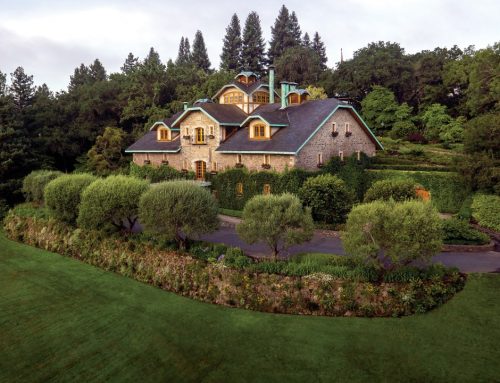
From its perch among the trees in the western hills of Oakville, the wines produced here are not just some of the most revered in the world, but also among the most honest and transcendent expressions of where they’re grown. They are wines of place, of truth. It’s a vision that Bill Harlan had when he founded the estate nearly 40 years ago, and one that’s been fine-tuned and perfected over the decades.

The wines of Harlan Estate are the product of a beautiful, respectful, incisive conversation between the people who call this place home and the land on which it’s built. It continues vintage after vintage in the most profound and delicious way imaginable.

Visiting Harlan, and Acquiring the Wine
The Harlan team members are so laser focused on their work with the land and in the winery that visits are not open to the public. That doesn’t mean, however, that experiencing the wine is an impossibility. Indeed, bottlings from across the Harlan portfolio grace the wine lists of top restaurants around the world. And high-end wine retailers also offer Harlan Estate wines.
You can also request to be added to the waiting list to eventually gain entry to their allocation list in order to purchase the wines directly from the estate.