Lokoya Wines in St. Helena, Napa Valley
Mountain wines have been on a tear in recent years, and few winemakers are more widely associated with the best of them than Chris Carpenter
Chris Carpenter is winemaker for some of the finest wines not just in the Jackson Family Wines portfolio, but in the world. And for all of the wines he crafts—names like Cardinale and La Jota get the pulses of collectors racing—Lokoya is perhaps the most celebrated.

“It sits at the top of the totem in the Jackson Family world,” Carpenter says. He adds: “We like to think that Lokoya resides at the top of the proposition in general in Napa across all producers, that we pursue the same kind of winemaking sensibility and positioning and attention to detail that the very best producers in Napa Valley do. And that’s how, as a winemaker and vineyard overseer, we operate for Lokoya. I don’t pull any punches on how Lokoya is made and how the fruit is grown. It gets all the resources and all the attention that it deserves.”
The results of those efforts are clearly evident in each of the four different bottlings of Lokoya that Carpenter crafts, each one an exquisite showcase of a different mountain appellation as seen through the lens of Cabernet Sauvignon. Vintage after vintage, they are crystal-clear evocations of their place of origin, the vintage, and the uncompromising dedication to quality that Carpenter and JFW insist on.

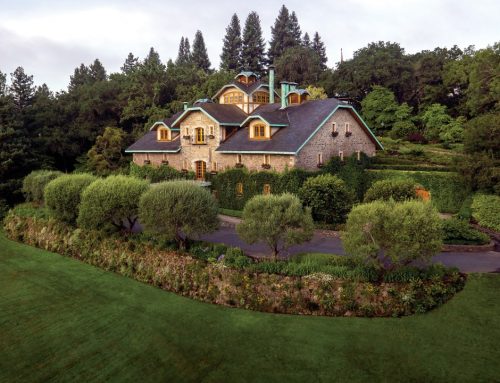
Tastings of all four mountain appellations that Lokoya produces must be booked in advance, and cost $225 per person. They’re held in the absolutely gorgeous Lokoya estate on Spring Mountain, soaring at more than 2,000 feet above sea level. For all the grandeur of the views and the surroundings, however, the space itself is just as magnificent. It’s based on the original 1960s stone winery, but was brought to vivid, light-streamed life by renowned architectural firm Backen, Gilliam & Kroeger.
The result is jaw-dropping yet also warm, bringing together impressive stonework and archways with the clean lines and more current aesthetic sensibility that Backen is so respected for. It’s the perfect place to experience wines that mirror that sensibility, both rooted in the history of the location yet thoroughly contemporary in their uncomprising attention to every last detail. Appointments are available for groups of two to six people.


A Tale of Four Mountains
“The way I think about it, for the four mountains that it’s produced off of, it should be the standard bearer for each mountain,” Carpenter notes. “When I’m producing it, I want it to express that mountain terroir through the lens of Cabernet at the very highest level, so that if you taste Lokoya Mt. Veeder next to other producers on Mt. Veeder…it is meant to be the highest expression of what that mountain produces in terms of its textures, acid, tannin, structure, all of those components that make up how we think about individual terroirs.”
These are deeply evocative wines. “If you line the four of them up, what separates each one of those wines isn’t the winemaking but the place. So,” he continues, “this is truly a wine of place, and I work really hard to keep that understanding consistent across all four mountains so that you would never be confused opening the four bottles between Howell Mountain and Diamond Mountain and Spring Mountain and Mt. Veeder. Each one would speak for themselves at the very highest level.”

Each of those four mountain sites boasts different micro-climates, soil composition, aspects, and underlying geology. Those differences are exactly what Carpenter is most interested in exploring through the lens of his fantastically age-worthy Cabernet Sauvignons. To that end, then, he keeps his winemaking consistent across all four bottlings, the better to express the differences between the individual terroirs without the obscuring screen of variations in winemaking technique.

Lokoya’s first vintage was 1995, but it wasn’t until 2005 that it released the four Cabs that are associated with the brand today. As such, ’05 was a turning-point year not just for Lokoya, but for the wines of Napa Valley in general: For a long time, the most prestigious wines were either from valley floor or hillside appellations. Lokoya proved that exploring the mountains exclusively could be every bit as exciting and elucidating.

Still, the nature of mountain winemaking meant that there was a period of exploration and experimentation. “There’s a learning curve whenever you’re dealing with vineyards and they’re new to you,” Carpenter notes. “I mean, any winemaker who tells you that they can understand the vineyard after one year, they’re not being honest. Especially in the mountain appellations where there’s so much variability—you’re dealing with different angles to the sun, different elevations, different soil types, different soil depths, different water holding potential, all the things that create the variability in any mountain vineyard—that takes a little while to learn, and it’s not after one year. That’s why we started buying fruit on Spring Mountain in 2003, and it took me three years to figure out where in this vineyard is the sweet spot, and is it at Lokoya-level quality?”
Wines for the Cellar, and for the Future
Given the different mountain appellations of each of the four Lokoya bottlings, it only makes sense that they express themselves uniquely. Understanding their differences, both in their youth and—perhaps more importantly—in their maturity, is important when collecting them.
“They’re all very age-worthy,” he says, adding: “What I’m really thinking about is how does a collector bring those wines into their cellar, and how do they explore them as they evolve over the course of 20, 30 years. And so I don’t pull punches on the structural side of the wines.”
As a general rule, Carpenter explains, “The most approachable of the Lokoyas on a regular basis is the Diamond Mountain. Diamond is in the northern part of the valley, so it gets a little bit more of that heat as the marine layer drains off. It’s got probably the highest pH and the lowest acid typically of the four.” It also boasts “the most evolved tannins, making this a wine that if you’re buying the four Lokoyas, it’s the one that you’re going to probably open the earliest: It’s got the most weight in the middle body, the most rounded tannins, and chocolate-covered cherry with a wee bit of mint defines it from an aromatic and flavor standpoint.”
“After Diamond would be Spring Mountain, which is really unique. It’s got its own kind of expression across all four of the wines in that it has probably the most red fruit and floral notes. It’s got this really great dark cherry character that carries over in that red fruit before it crosses into the black fruit side of the equation. It’s got an incredible floral aromatic combination of orange blossom and rose. It’s got really fine tannins and a minerality that…is really prevalent and creates a lot of the energy in the wines. The tannins tend to be fine but directed: They’re not nearly as round as they are up on Diamond Mountain; they have a little bit more of that presence, and the acids are always just energy-driven, perfectly balanced with the concentration of flavor.”

The Howell Mountain Cab is even more structural. Lokoya’s Cabs from there tend to boast “a much more Bordeaux-like expression of Cabernet from Napa Valley: A lot more of that herbalness that you associate with Bordeaux, a lot more of that gravelly minerality. The tannins are quite broad, but it does have a tremendous amount of depth. Unlike Bordeaux, it carries a lot of the weight of Napa Valley with those more Bordeaux-like structural and acid and herbal characteristics. And it’s always the textural component of Howell Mountain, it’s always something that it stands out from the other three in a really weighty kind of textural way on your palate.” The fruit of this expression tends to be darker, in the realm of blackberries and boysenberries.
Finally, the Mt. Veeder bottling tends to benefit from the most age. This one, Carpenter says, is defined by “blue fruit and violets and acid and wet-shale-after-a-rainstorm minerality, and a tannin component that goes on forever and creates this chewy backbone to that wine that, if you’re buying that for your kid, you’re going to drink it when they’re in that 21 to 25 range, when they’re celebrating their ascension into adulthood. This is the wine that you buy for them because you can pretty much guarantee that’s going to carry a lot of that fruit given the tannin concentration in it.”
All of the wines of Lokoya, however, stand the test of time. And for all of their differences—which are what make them so fascinating and rewarding to collect and explore—the threads that tie them together are the consistent expression of their mountain origins, and the uncompromising commitment to the highest quality that Carpenter insists on for them all.