Sonoma Wineries with Stunning Architecture and Design
Featuring Ram's Gate,, Silver Oak, Donum Estate, Cuvaison Winery and many more.
In writing my first book, The New Architecture of Wine, I spent a year exploring the wineries of California, including beautiful Sonoma County — home to 19 AVAs.
Sonoma County is known for its brilliant wines, more casual vibe and stunning scenery. But the region has another important, though sometimes overlooked draw: architecture and design. The county’s widely varied topography and microclimates are reflected in buildings and interior that are every bit as diverse.
Consider Kistler Vineyards’ traditional (and historic) design or Aperture Cellars’ contemporary angles. Stryker Sonoma (now Foley Sonoma), designed by Nielsen:Schuh Architects, was one of the first wineries to truly express the landscape in its design. A recent addition to the Sonoma County winery canon – Occidental Wines in the West Sonoma Coast AVA, beautifully expresses its location and wine.
Wine enthusiasts often refer to terroir – the combination of soil, sun, temperature and other factors that influence a wine’s characteristics. These same factors, along with the varied passions of the region’s winemakers and the characteristics of the wine produced, also influence the structures where wine is made and enjoyed.
Here are some of my favorites.
Ram’s Gate Winery
Set in rolling topography of the Carneros AVA, and is one of the first wineries visitors encounter on their journey to the Napa and Sonoma Valleys from San Francisco, Ram’s Gate is truly the gateway to the wine country. Designed by the late Howard Backen, principal Luca Pignata, (now founding principal of his own firm, Luca Studio) and the team at Backen, Gillam & Kroeger, (now Backen & Backen), Ram’s Gate provides a fitting welcome to California’s revered wine country. Set atop a knoll overlooking vineyards and the adjacent San Francisco Bay, the agrarian-inspired structure is an ode to the weathered farmsteads of old Carneros.
The 22,000-square-foot winery is actually a collection of indoor/outdoor structures circling a central courtyard, and it feels like a small village. This design concept actually goes back centuries, to when the central courtyard was not only where the grapes were collected and wine was made, but also where visitors were welcomed and harvest was celebrated. Here you’ll find an abundance of indoor/outdoor spaces, making it easy to return again and again, never having the same experience twice.

The Donum Estate in Sonoma
Set at the edge of the bay in Carneros, Donum Estate is renowned for its Pinot Noir, its modern take on Sonoma’s agrarian architecture and its astounding art collection, which is very likely one of the most important private collections of large-scale sculpture in the world, with works by Louise Bourgeois, Ai Wei Wei, Doug Aitken, Keith Haring and many others.
The experience of wine and place at this estate is unparalleled. Inspired by the site’s original dairy farm, architect Matt Hollis designed an estate composed of several structures scattered amid the vineyards, the sculpture collection and the site’s working farm. The gabled structures, painted in all white, form a fresh take on the vernacular of Sonoma’s heritage dairy farms. Playing with the traditional board-and-batten siding, the architect varied the pattern, increasing and decreasing the widths to reflect the rolling topography. Inside, the tasting areas are clean and spare, with a Scandinavian-inspired simplicity that forms a perfect background for both the wine and the art.

Hamel Wines in Sonoma
Hamel Family Wines is set on a 125-acre, gently-sloping parcel at the base of the Mayacama Mountain Range, very near the center of the Sonoma Valley AVA. Once owned by William Randolph Hearst, the land lies just uphill from Highway 12, which traverses the Sonoma Valley and acts as its quintessential wine road. On this site, architect Douglas Thornley designed a clean, contemporary winery clearly informed by his experience studying design in Denmark. The hospitality building floats like a jewel box over the sloping site and continuous clerestory windows flood the interiors with light. An impressive pair of rammed-earth walls runs the length of the buildings, grounding the entire wine-tasting experience in the language of the land. The 12,000 square feet of caves cut into the hillside behind the hospitality building provided the material for the rammed-earth walls and now house a VIP tasting experience, in addition to barrel storage.

La Crema Estate in Windsor, Sonoma County
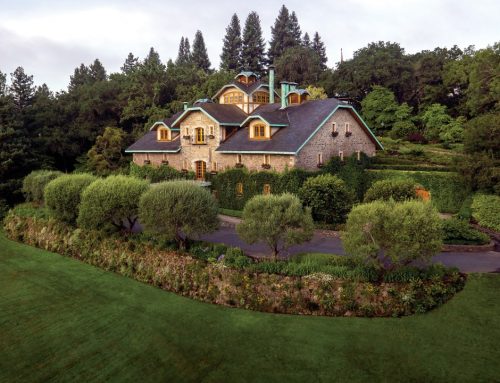
Owned by Jackson Family Wines, La Crema sits along the Russian River Valley on land once owned by Saralee and Richard Kunde, legendary in Sonoma County for both their leadership in agriculture and their generous philanthropic spirit. La Crema’s hospitality building is set in the couple’s former home – which they had converted from a barn once used to house hops and horses. The historic redwood barn had been restored and converted to hospitality use by Brayton Hughes Design studio, a San Francisco firm well-known for hospitality design. The converted barn is a fusion of residential and agricultural style, its dark wood interiors polished and revived, and filled with cozy furnishings that are soft and inviting. Magically, La Crema feels rustic and sophisticated at the same time, with a multitude of intimate spaces carved out within the three-story structure. The “oh wow” moment comes when you ascend the barn’s original circular stair, which at first obscures, then gradually reveals, the barn’s towering three-story volume.

Kistler Vineyards in Forestville, Sonoma County
Set atop a knoll in the tiny wine country town of Forestville, Kistler Vineyards feels like something out of an agrarian fairytale. An all-white farmhouse with a sweeping stairway leads to several peaceful terraces, which step down the hill toward an idyllic pond and newly reconstructed barn. Founded by legendary winemaker Steve Kistler, (now proprietor of Occidental Winery, also profiled in this article), Kistler is now owned by Bill Price of Price Family Wines. Offering wine tasting experiences in the historic farmhouse – once a raucous roadhouse – and the barn, this is a place with history in its bones and an eye toward the future. Renovated by San Francisco-based Architectural Resources Group to reflect what they call “farmhouse with an edge,” the farmhouse has traditional elements in front balanced by all-white, wide open spaces in back. Down by the pond, the group used siding salvaged from the original barn to clad the soaring interior tasting spaces, adding all new siding on the exterior. A set of 14-foot crimson doors – arguably the barn’s most distinctive feature – provide the design’s exclamation point.

MacRostie Vineyards & Winery in Healdsburg, Sonoma County
In my book The New Architecture of Wine, I called this project “A House for Steve,” for owner Steve MacRostie, who is the heart and soul of MacRostie Vineyards & Winery. It is truly impossible to imagine a more perfect setting for a winery – or an estate house as the MacRostie team calls it. Gently rolling hills converge to cradle the winery, providing views in every direction. The architecture – again designed by architect Douglas Thornley – is residential in scale, and incredibly welcoming, reflecting the winery staff’s relaxed, personal approach, (every guest is greeted with a glass of wine upon arrival). With its simple gabled form, walls of windows and multiple terraces, it is a place that encourages its visitors to slow down and stay awhile, and almost everyone does. When you go, be sure ask your host to point out the famous “five-hour couch.”

Aperture Cellars in Healdsburg, Sonoma County
Aperture Cellars, designed by Napa-based Signum Architecture, was completed in 2020 – just after The New Architecture of Wine was published. If I am fortunate enough to write a second volume, this winery will be at the top of my list. It is one of my absolute favorite wine tasting experiences – a completely unique structure that pushes the envelope while still managing to tell an intimate story of its owner and winemaker. Designed for rising star Jesse Katz and his father, famed photographer Andy Katz, the design concept for both the production winery and small hospitality building is based upon the study of an aperture.
Architect Juancarlos Fernandez ingeniously deconstructed the elements of the aperture, then reassembled them in differing ways to form the two buildings. The hospitality space, which unfolds to embrace the adjacent vineyards, is filled with light, its central space topped with a massive hexagonal oculus. The result is a gallery-like space that forms a perfect background for the wine, and for Andy’s stunning photography.

Flowers Vineyards & Winery in Healdsburg, Sonoma County
Flowers Vineyards & Winery’s hospitality building’s simple, gabled volumes are nestled into a grove of redwoods and extensive gardens, for an experience that is peaceful and grounded in place. The contrast between the all-black exterior and interiors clad in light oak is striking – simple and elegant, with the air of a beautifully refined home. My favorite tasting spot, however, is in the gardens, where tasting pavilions are nestled into a landscape alive with flowers and pollinators. The architects – San Francisco-based Walker Warner – had the creative confidence to put the landscape front and center, and it’s magical.

Medlock Ames Winery in Healdsburg, Sonoma County
Visiting the Medlock Ames tasting room in the Alexander Valley is a joy. Set within the former Alexander Valley Store, at the crossroads of the valley’s two main roads, this small tasting room is filled with history and a sense of community. Marin-based architects Luke and Ani Wade dismantled the original store and re-used 80% of the materials to create a new, light-filled space that keeps the building’s quirky history and identity intact. Winery owners Chris Medlock James and Ames Morrison surrounded the tasting room with a biodynamically-farmed garden, used to grow food for pairings and demonstrate their sustainable farming ethos. For wine club members, the winery’s Bell Mountain vineyard and barn is another journey nearby that must not be missed.

Silver Oak Winery Alexander Valley in Healdsburg, Sonoma County
Designed to “frame the vineyards,” Silver Oak is set amid a 113-acre estate and 75 acres of Cabernet Sauvignon vineyards. In April 2020, the winery was certified as a Living Building by the International Living Future Institute – which recognizes structures that give back more than they take – only the 26th building in the world to be given the designation. The long gabled buildings are a thoroughly contemporary take on the valley’s agrarian history – solid, but transparent, with extruded roof lines that form shaded outdoor tasting areas. The emphasis here is placed squarely on experiencing every element of the site and the wine-making experience.

Occidental Winery in Bodega, Sonoma County
A visit to Occidental Winery is an otherworldly experience. Perched on a hillside overlooking the ocean within the Sonoma Coast AVA, this winery founded by Steve Kistler is just five miles from the Sonoma Coast. The beautifully-restrained structures housing the production winery and tasting room – designed by the husband-wife team ast Nielsen : Schuh – together form one of the purest expressions of place I’ve seen, perfectly embodying the simplicity and transparency of Steve Kistler’s approach to making coastal Pinot Noir. The winery’s two structures are carefully sited to fit into the site, simply crafted of steel, glass, wood and board-formed concrete, with canted roofs echoing the slope of the hillside. The tasting room is a dance of opposites, with clerestory windows lifting the delicate roof aloft above weighty concrete walls, while walls of glass open to views of the vineyard.